 DriveCircle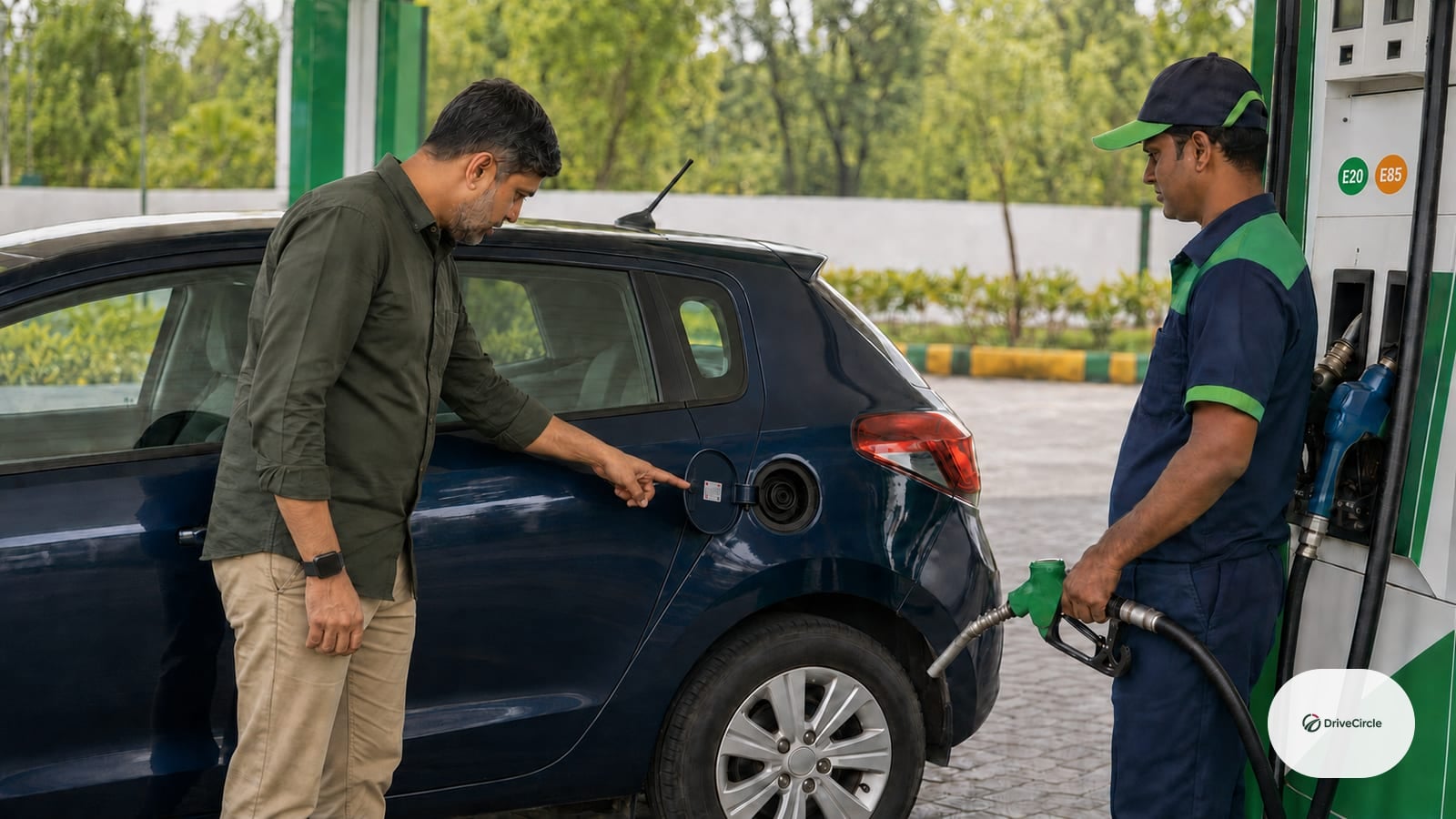
Two ethanol-blended fuels are now part of daily life for Indian drivers. E20 (20% ethanol) became mandatory for every oil company and private fuel retailer from April 1, 2026. E85 (80-85% ethanol, for flex-fuel vehicles only) launched on World Environment Day at 48 stations and is expanding toward 500 stations by the end of the year. Both were introduced with an official guarantee of safety — and both have triggered real, public pushback from owners.
The Controversy
Since E20 went fully nationwide, a large volume of owners have reported problems on social media: reduced mileage, rougher engine performance, and more frequent workshop visits. Mechanics quoted in multiple reports describe fuel injectors developing deposits that require replacement — a set of four injectors reportedly costing roughly ₹7,000-8,000. The volume of complaints grew large enough to become a genuine political story: a prominent former Delhi Chief Minister publicly wrote to 29 automobile manufacturers demanding written confirmation of E20's safety for vehicles made before 2023, and asked whether affected owners would be compensated.
The Official Position
The government's position has been consistent and firm: E20 is completely safe. The Union Transport Minister publicly challenged critics to name even a single vehicle actually damaged by E20, stating no such case had been documented. The Society of Indian Automobile Manufacturers has said millions of vehicles are already running on E20 with no reported breakdowns or engine failures, and the Supreme Court dismissed a petition seeking to challenge the ethanol-blending mandate. The petroleum ministry has gone further, stating E20 does not cause a drastic mileage drop and can even modestly improve performance in engines properly tuned for it.
When automakers responded to the political pressure, their answer was narrower than a flat denial: pre-2023 vehicles can safely run on E20, the only acknowledged drawback is a possible mileage reduction — not mechanical damage. None of the 29 manufacturers reportedly gave the requested response in writing.
The government's most authoritative statement yet came on July 30, 2026, when Union Minister Nitin Gadkari replied in the Lok Sabha to a direct question on E20's impact, citing a joint study by ARAI, SIAM and IOCL. The reply put a number on what had previously been a debate of anecdotes: a 2-6% fuel economy reduction, varying by vehicle category and vintage — and stated that dynamometer engine-durability tests and on-road vehicle tests "have not shown any failures due to E20." The reply also claimed E20 delivers better acceleration and improved ride quality in properly tuned engines, and roughly 30% lower carbon emissions than E10, since higher ethanol content supports cleaner, more complete combustion.
What's Actually, Verifiably True
Both the "it's safe" and "my mileage dropped" claims can be true at once, because they answer two different questions — and the mileage effect has a simple, unavoidable technical explanation, not a hidden defect. Ethanol contains meaningfully less energy per litre than pure petrol — roughly 30% less. Blend any ethanol into petrol and your engine needs more fuel volume to produce the same energy, full stop. Independent estimates had already converged on a real range of 1-6% mileage loss depending on vehicle age and tuning; the government's own July 30 Parliament reply now confirms the same 2-6% figure officially, with older/uncalibrated vehicles at the higher end. That is a genuine cost to owners, and it is completely consistent with "no engine damage" being true at the same time.
The July 30 reply also surfaced a detail that had gotten little attention until now: vehicles registered from April 1, 2005 with BS-III engines, manufactured before 2016, may need rubber fuel-system parts and gaskets replaced to safely handle E20 — a manageable fix during routine servicing, but a genuinely new, specific piece of guidance for owners of older vehicles, not just a blanket "it's fine."
Where the honest, still-unresolved gap sits is narrower than either side's public statements suggest: the mileage-loss science is now settled and both sides broadly agree on it. What the government's reply notably did not do is explain why the underlying ARAI/SIAM/IOCL study itself hasn't been made public, or say whether a formal advisory will be issued to help BS-III owners get those rubber parts checked. The specific mechanic claims about injector deposit buildup and repeat replacement costs are also a different, more serious allegation than a mileage dip — and one that still hasn't been addressed with the same directness as the mileage question. That transparency gap, not a blanket safety cover-up, is the real substance of the ongoing dispute.
What This Actually Means for Your Car
- No credible, verified report has tied E20 to outright engine failure — the "unsafe" framing going around is broader than what's actually been substantiated, and the government's own July 2026 Parliament reply backs that with durability-test data.
- Do expect a real mileage change, more so if your vehicle is older or was never recalibrated for E20 — the officially confirmed range is 2-6%, so budget for it rather than assume brochure figures still apply.
- If your vehicle was registered from April 2005 with a BS-III engine and made before 2016, ask your service center to check rubber fuel-system parts and gaskets during your next routine service.
- If you notice rough idling, hesitant acceleration, or your service center flags injector deposits, don't dismiss it as unrelated to fuel — log the date, odometer and symptom, and raise fuel type specifically when you report it.
- E85 is flex-fuel-only and not interchangeable with E20 — check your vehicle's actual compatibility before ever using it; putting E85 in a non-flex-fuel engine is a different and much bigger risk than the E20 mileage debate.
- Track your own before/after mileage across a genuine fuel-type change. A remembered impression ("it feels worse") is far weaker evidence than a logged number when you're deciding whether to raise it with your dealer.
This is exactly the kind of before/after data point that's easy to lose track of and genuinely useful to have on record — which is why DriveCircle logs your fuel type, cost and mileage automatically, fill after fill, so a real change shows up as a number, not just a feeling.