 DriveCircle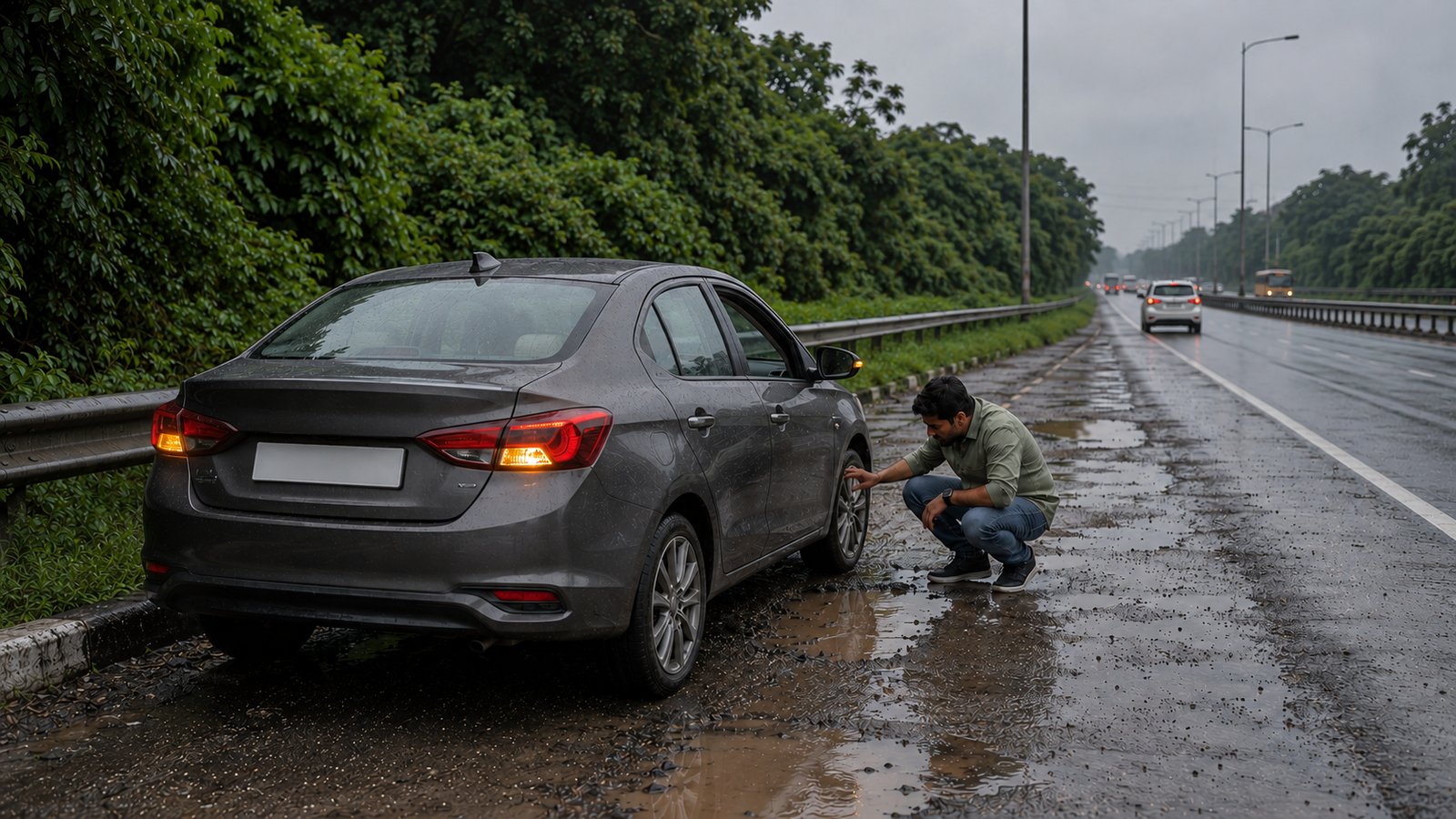
Indian monsoon roads can turn a normal drive into an expensive repair in one second. You see water on the road, the car drops hard into a hidden pothole, and suddenly there is a loud thud from the front wheel.
Most drivers check only one thing after this: “Is the tyre punctured?”
That is not enough.
A pothole impact can damage the tyre, alloy wheel, wheel alignment, suspension, steering components and even the underbody. Sometimes the car looks fine immediately after the impact, but vibration, pulling, tyre bulge or suspension noise appears later.
Here is a practical DriveCircle guide on what to check in the first few minutes after hitting a pothole, how to collect evidence safely, and when car insurance may or may not help.
First rule: stop safely before inspecting anything
Do not stop in a live lane just to check the wheel. That is more dangerous than the pothole itself.
If the car is still controllable, slow down gradually, use indicators or hazard lights, and move to the left shoulder, a service lane, a fuel pump, a lay-by or another safe area. Avoid sudden braking unless there is immediate danger behind you.
Once stopped safely:
- switch on hazard lights;
- keep passengers away from moving traffic;
- do not stand between the car and active lanes;
- avoid opening doors toward traffic;
- inspect only from the safe side of the vehicle.
If the tyre has burst, the car is pulling strongly, or steering feels unstable, do not continue at highway speed. Call roadside assistance, your insurer, or 1033 if you are on an NHAI tolled National Highway stretch and need highway help.
What to check immediately after hitting a pothole
Start with a quick visual and driving-feel inspection. You are not diagnosing the whole car on the roadside; you are deciding whether it is safe to move further.
1. Tyre sidewall
Look at the tyre sidewall carefully. A pothole impact can pinch the tyre between the rim and the road edge.
Watch for:
- cuts;
- bubbles or bulges;
- sidewall swelling;
- exposed cords;
- rapid air loss;
- deep scuff marks.
A sidewall bulge is serious. It means the internal tyre structure may be damaged. Do not ignore it just because the tyre still holds air.
2. Alloy wheel or steel rim
Alloy wheels can bend or crack after a hard impact. Steel rims can also deform.
Check for:
- bent rim edge;
- visible crack;
- new vibration after impact;
- air leakage from the bead area;
- wheel wobble;
- fresh scraping or impact marks.
Even a small bend can cause slow air loss or vibration at speed. If you feel vibration after the impact, get the wheel balanced and inspected.
3. Steering pull
After stopping safely and checking the tyre visually, drive slowly for a short distance only if the car appears safe.
If the steering pulls left or right, the alignment may have shifted. Do not assume this is minor. Bad alignment can wear tyres quickly and make the car unstable during braking or highway driving.
4. Suspension noise
Listen for new sounds:
- clunking;
- knocking;
- squeaking;
- metal-on-metal sound;
- thud over small bumps;
- unusual steering noise.
These can indicate damage to suspension arms, struts, shock absorbers, mounts, ball joints or steering components. A workshop inspection is needed if the sound continues.
5. Underbody and fluid leaks
A deep pothole can scrape the underbody, especially on low-ground-clearance cars.
Check the ground after stopping. If you see fresh fluid dripping, do not continue driving casually. Engine oil, coolant, brake fluid or transmission fluid leakage can quickly turn a small impact into a major failure.
When should you stop driving immediately?
Do not continue driving if you notice any of these:
- tyre burst;
- sidewall bulge;
- visible rim crack;
- steering wheel shaking badly;
- car pulling strongly to one side;
- brake warning light;
- fluid leak;
- loud suspension knock;
- wheel rubbing against the body;
- ABS, steering or suspension warning light;
- unusual burning smell.
In these cases, it is safer to call roadside assistance or arrange towing than to “somehow reach home.”
Should you take photos for insurance?
Yes, but only if it is safe.
Do not stand in a live lane or walk into traffic to photograph a pothole. Your safety matters more than evidence.
If the vehicle is safely parked and you can take photos without entering traffic, capture:
- the damaged tyre or rim;
- the pothole or broken road patch;
- the car’s position after stopping safely;
- surrounding landmark or location;
- waterlogging, if relevant;
- dashboard warning lights, if any;
- towing or roadside-assistance receipt;
- repair estimate and invoice.
Also save the location from Google Maps or another navigation app. If the impact happened on a National Highway, note the nearest toll plaza, kilometre marker or landmark.
Does car insurance cover pothole damage in India?
The honest answer is: it depends on your policy and the exact damage.
A third-party-only policy will not cover damage to your own car. For your own vehicle damage, you need own-damage cover or a comprehensive/package policy.
Even then, not every pothole-related cost is automatically covered.
Insurance may be more likely to help when the damage is treated as accidental external impact damage to the vehicle. For example, a hard pothole impact damages the wheel, suspension or underbody along with other covered parts.
But tyre-only damage, normal wear and tear, alignment, balancing, consumables, depreciation and mechanical failure may be restricted or excluded depending on your policy wording.
This is why you should call your insurer before authorising major repairs, especially if the estimate is high.
Tyre and rim protection add-on: when it matters
Many standard policies treat tyres differently from other parts because tyres are wear-and-tear items. Some insurers offer tyre protection or tyre-and-rim protection add-ons.
These add-ons may help with:
- tyre sidewall damage;
- tyre bulge after impact;
- alloy wheel or rim damage;
- labour and related replacement cost, depending on policy wording.
But add-ons vary by insurer. Some cover accidental tyre damage only when the vehicle is not driven further after the damage. Some have claim limits, depreciation rules, exclusions for worn tyres or restrictions based on tread depth.
So before assuming coverage, check:
- whether tyre/rim protection is active;
- what type of tyre damage is covered;
- whether alloy wheel repair or replacement is included;
- claim limit per year;
- depreciation and deductible;
- whether continued driving after damage affects the claim.
Should you claim insurance or pay yourself?
Do not claim blindly for every small pothole repair.
Consider an insurance claim if:
- alloy wheel replacement is expensive;
- suspension parts are damaged;
- underbody repair is required;
- multiple tyres/wheels are affected;
- repair estimate is much higher than deductible and possible No Claim Bonus impact.
Consider paying yourself if:
- damage is minor;
- repair cost is close to the deductible;
- only wheel alignment or balancing is needed;
- claiming will reduce your No Claim Bonus more than the repair cost;
- the policy clearly excludes the item.
If you are unsure, ask the insurer for a claim estimate before finalising the decision.
Workshop checks after a pothole impact
Even if the car feels normal, get a workshop check if the impact was hard.
Ask the technician to inspect:
- tyre sidewall and tread;
- alloy wheel bend or crack;
- wheel balancing;
- wheel alignment;
- suspension arms and bushings;
- shock absorber or strut;
- steering rack and tie rods;
- wheel bearing;
- underbody scrape marks;
- brake hose and ABS sensor wiring near the wheel.
After repair, take a short test drive and check whether the steering is straight, the car tracks properly and there is no vibration at normal road speeds.
Can you report a dangerous pothole?
Yes, but the reporting route depends on the road authority.
If the pothole is on an NHAI tolled National Highway stretch, you can call 1033 to report hazardous road conditions. The helpline accepts road-condition complaints such as potholes and unsafe highway issues.
For city roads, state highways or local roads, the responsible authority may be the municipal corporation, PWD, state highway authority, traffic police or local civic body. Many cities also have public grievance apps or helpline numbers.
When reporting, share:
- exact location;
- direction of travel;
- nearby landmark;
- photo or video, if safe;
- whether the pothole is causing immediate traffic danger.
DriveCircle checklist: after hitting a pothole
Use this simple sequence:
- Slow down and move to a safe left-side shoulder or service lane.
- Switch on hazard lights.
- Keep people away from traffic.
- Check tyre sidewall, rim and air loss.
- Look for leaks or warning lights.
- Take photos only if safe.
- Drive slowly only if the car feels stable.
- Stop again if there is vibration, pull or noise.
- Call insurer before major repair.
- Get tyre, rim, alignment and suspension inspected.
DriveCircle verdict
A pothole impact is not just a tyre problem. It can affect the rim, suspension, steering, alignment and underbody.
The safest approach is simple: stop only at a safe place, inspect from the shoulder side, do not stand in traffic, and do not continue high-speed driving if the tyre, steering or suspension feels wrong.
For insurance, remember that coverage depends on your policy type, damage type and add-ons. A comprehensive policy may help in some accidental damage cases, but tyre-only damage and wear-related costs are often treated differently.
If the impact was hard, get the vehicle inspected even if it looks fine. The cheapest repair is usually the one you catch before it becomes a bigger safety problem.
FAQ
What should I check first after hitting a pothole?
First stop safely. Then check the tyre sidewall, air pressure, rim edge, steering feel, warning lights and any fluid leakage.
Can a pothole damage an alloy wheel?
Yes. A hard impact can bend, crack or scrape an alloy wheel. Even a small bend can cause vibration or slow air leakage.
Is a tyre sidewall bulge dangerous?
Yes. A sidewall bulge can indicate internal tyre damage. Avoid high-speed driving and get the tyre inspected or replaced.
Does car insurance cover pothole damage in India?
It depends on your policy. Third-party insurance will not cover your own car damage. Own-damage or comprehensive cover may help for accidental impact damage, but tyre-only damage, alignment and wear-related items may be restricted unless you have relevant add-ons.
Should I claim insurance for pothole damage?
Claim only if the repair cost is meaningfully higher than the deductible and possible No Claim Bonus impact. For minor alignment or balancing work, paying directly may be more practical.
Can I keep driving after hitting a pothole?
Only if the tyre looks safe, there is no air loss, no bulge, no warning light, no fluid leak and the car drives normally. If there is vibration, pulling, noise or visible damage, stop and get help.
Can potholes damage suspension?
Yes. Potholes can damage suspension arms, bushings, struts, shocks, mounts, steering parts and wheel bearings.
Can I report potholes on 1033?
You can call 1033 for road-condition complaints on NHAI tolled National Highway stretches. For city or state roads, use the relevant local authority or civic complaint channel.
Sources
- IMD weather bulletin, 13 August 2026
- Times of India — Gurgaon roads develop potholes and craters after rain
- Times of India — Bengaluru damaged-road fatal incident
- IRDAI-hosted standard private-car policy wording
- ICICI Lombard — tyre protection add-on cover
- IHMCL — 24×7 National Highway Helpline 1033