 DriveCircle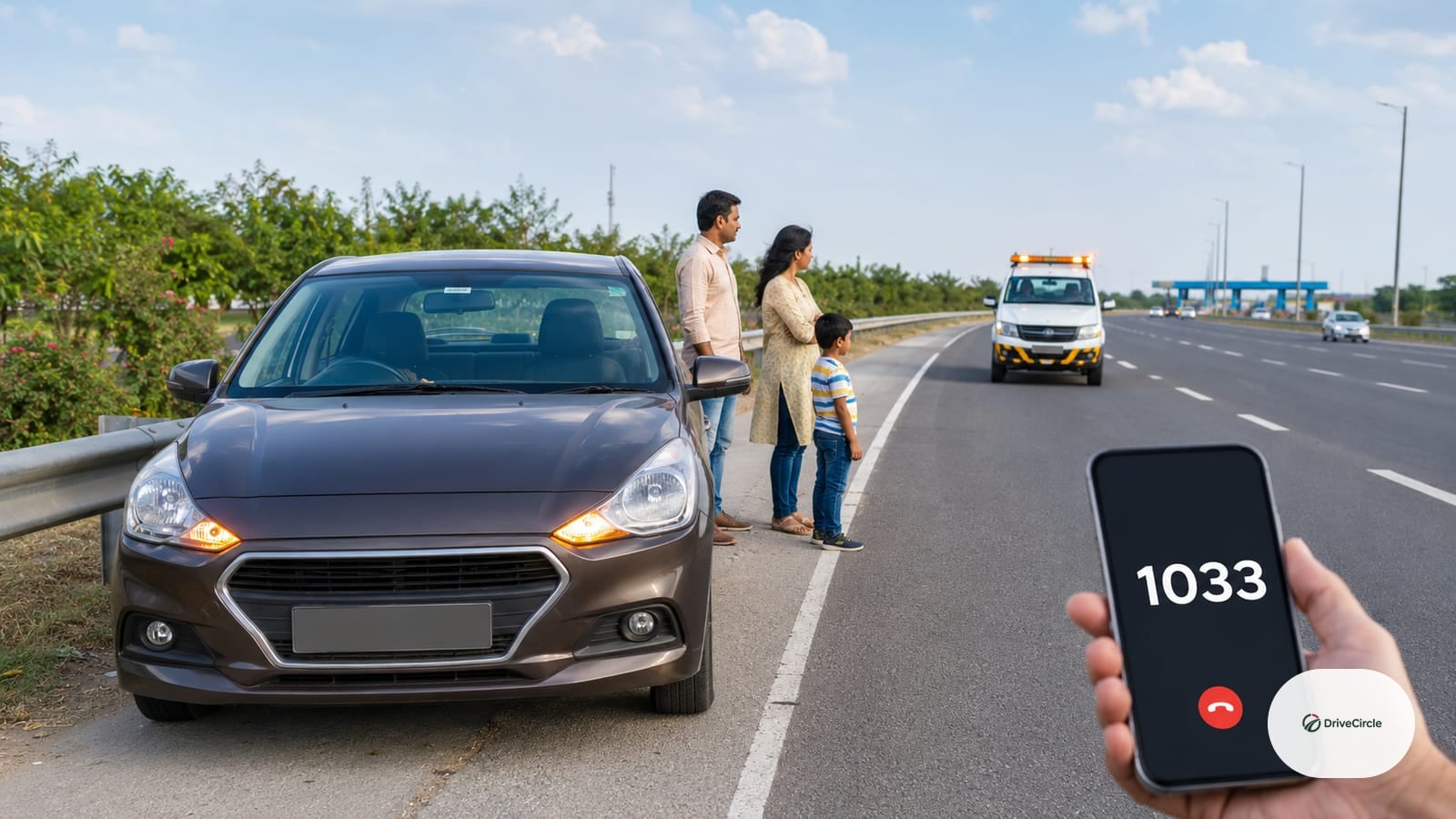
If you drive on Indian highways, one number should already be saved on your phone: 1033.
The NHAI Helpline 1033 is a toll-free highway assistance number for road users on NHAI's tolled National Highway stretches. It is meant for both emergency and non-emergency situations, including accidents, breakdown assistance coordination, FASTag complaints, toll-related issues and unsafe road-condition reporting.
But there is one important thing to understand before you rely on it: 1033 is not a magic replacement for every emergency number or every private roadside-assistance plan. It is a highway helpline that can coordinate support depending on your location and situation.
Here is a practical DriveCircle guide on when to call 1033, what help it may arrange, when to call 112 instead, and what details you should give if your car breaks down or you see an accident on a National Highway.
Quick answer: what is NHAI Helpline 1033?
1033 is a 24x7 toll-free helpline for road users on NHAI's tolled National Highway stretches.
According to Indian Highways Management Company Limited (IHMCL), the helpline provides multilingual support and can connect with highway operations facilities such as toll-plaza ambulance, patrol vehicle and crane support depending on the need.
The helpline also accepts non-emergency complaints and feedback related to:
- FASTag issues
- toll charges
- toll-plaza facilities and amenities
- road conditions
- potholes
- streetlights
- other highway-maintenance concerns
So, if you are on an NHAI-managed tolled highway and something goes wrong, 1033 is a number worth calling early.
When should you call 1033?
You should consider calling 1033 when you are on a National Highway stretch and need highway-specific help or need to report a highway issue.
Common situations include:
- a road accident on or near the highway
- a vehicle breakdown creating danger or obstruction
- a stationary vehicle in a risky position
- need for ambulance coordination after a highway accident
- need for patrol assistance
- need for crane or recovery coordination after a crash or obstruction
- potholes, damaged barriers or unsafe road conditions
- non-functional streetlights on highway stretches
- toll-plaza facility complaints
- FASTag-related complaints or queries
If the situation involves immediate threat to life, crime, fire, serious injury or general emergency response, you should also call 112, India's emergency response number. In many real situations, calling both can be sensible: 112 for emergency services and 1033 for highway-specific coordination.
1033 vs 112: which number should you call?
This is the part many drivers get confused about.
Call 1033 when the issue is connected to travel on an NHAI tolled National Highway stretch and you need highway assistance, patrol coordination, ambulance coordination, crane support, FASTag help or road-condition reporting.
Call 112 when you need emergency police, fire, medical or disaster-response support, especially if there is immediate danger to life or public safety.
For example:
- If your car breaks down on a National Highway shoulder and you need highway help, call 1033.
- If there is a serious accident with injuries, call 112 and 1033.
- If there is fire, violence, a crime or a life-threatening emergency, call 112 immediately.
- If you want to report a pothole, damaged crash barrier, streetlight problem or toll issue on an NHAI stretch, call 1033.
The simplest way to remember it:
1033 is highway help. 112 is emergency response.
What help can 1033 arrange?
IHMCL says the 1033 helpline is integrated with highway operations facilities such as toll-plaza ambulances, patrol vehicles and cranes depending on the need.
In practical terms, 1033 may help coordinate:
- ambulance support for highway accident victims
- highway patrol vehicle assistance
- crane support to remove wrecked or obstructing vehicles
- communication with nearby highway operations teams
- FASTag and toll-related support
- complaint reporting for road-condition issues
This does not mean every service is guaranteed in the same way everywhere. Response depends on the highway stretch, exact location, availability of support vehicles and the nature of the incident.
Do not assume a fixed response time. Do not assume every towing or recovery situation will be free. And do not wait silently if the situation is becoming dangerous. If there is immediate risk, call 112 as well and move to a safer location if you can do so without putting yourself in more danger.
Can 1033 help if your car breaks down?
Yes, 1033 can be useful if your car breaks down on an NHAI tolled National Highway stretch, especially if the vehicle is blocking traffic or is in an unsafe position.
But think of it as highway assistance coordination, not a full replacement for your manufacturer roadside assistance, insurance RSA or private towing contact.
If your car has a flat tyre, engine failure, battery issue or overheating problem, 1033 may help connect the situation to highway patrol or crane support depending on the risk and local availability. But for repair, replacement vehicle, paid towing to a workshop or hotel support, your private roadside-assistance plan may still be needed.
Before a long trip, keep these numbers saved together:
- 1033 — NHAI highway helpline
- 112 — emergency response
- your car manufacturer RSA number
- your insurer RSA number
- nearby family contact
- your FASTag issuer support number
This is exactly the kind of information a car-ownership app like DriveCircle should eventually store against each vehicle, because nobody wants to search for helpline numbers while standing on a highway shoulder.
What details should you give while calling 1033?
The quality of help often depends on how clearly you describe your location and situation.
When you call 1033, try to share:
- your name and mobile number
- whether it is an accident, breakdown, obstruction, road defect or toll issue
- highway name or route, if known
- direction of travel
- nearest toll plaza, exit, town, fuel pump or landmark
- kilometre marker, if visible
- vehicle type, colour and registration number
- number of people in the vehicle
- whether anyone is injured
- whether the vehicle is blocking a lane
- whether you need ambulance, patrol or crane support
- GPS location from Google Maps, Apple Maps, WhatsApp location or RajmargYatra, if available
If you are unable to identify the exact location, do not guess confidently. Tell the operator what you can see around you: toll plaza name, bridge, flyover, milestone, signboard, median, petrol pump, restaurant, village name or exit number.
What should you do while waiting for help?
Your first job is not to fix the car. Your first job is to stay alive.
If your vehicle can still move, slow down gradually and stop on the left shoulder or a safe lay-by. Avoid stopping in a live lane unless the vehicle cannot move. Switch on hazard lights immediately.
If it is safe, place the warning triangle behind the car at a reasonable distance so approaching traffic gets time to react. At night or in rain, be even more careful because visibility drops quickly.
Do not stand between your car and moving traffic. Do not gather behind the vehicle. Do not let children walk around the highway shoulder. If traffic is fast and the shoulder is narrow, move occupants behind the guardrail or to a safer area only if it can be done safely.
If there is an accident:
- check your own safety first
- call 112 if anyone is injured or in immediate danger
- call 1033 for highway-specific assistance
- do not move seriously injured people unless there is an immediate danger such as fire or oncoming traffic
- warn other drivers if you can do so safely
- avoid crowding the crash area
Can you report potholes, streetlights and toll issues on 1033?
Yes. IHMCL lists non-emergency issues under the 1033 helpline too, including road conditions, potholes, streetlights, toll charges, FASTag-related complaints and feedback about facilities or amenities at toll plazas and along National Highways.
This can be useful when you notice:
- a pothole or broken road patch
- damaged crash barrier
- faded lane marking
- non-functional streetlight
- debris on the road
- unsafe stopping area
- toll overcharging concern
- FASTag deduction issue
- poor toll-plaza facility or amenity
For FASTag disputes, also keep your issuer-bank or FASTag-provider complaint channel handy. 1033 can be a support route, but your issuer may still be needed for transaction-specific resolution.
RajmargYatra and newer digital highway safety updates
NHAI and IHMCL have also been working on digital highway safety systems. In March 2026, a PIB release said IHMCL signed an MoU with commercial-vehicle aggregator platforms to integrate RajmargYatra app features and a dedicated “Call 1033” option inside participating applications.
The release said consenting users of those platforms may be able to share geo-location information to support faster response and receive updates such as ambulance dispatch status and nearest hospital information.
That is useful, but drivers should not assume this feature is available inside every app or for every private-car user. For now, the safest advice remains simple: save 1033 directly in your phone and keep location sharing ready.
What 1033 may not cover
Drivers should use 1033 with realistic expectations.
It may not cover every road in India. NHAI describes the helpline for road users on NHAI's tolled stretches. A city road, village road, state highway or state expressway may be managed by another authority.
It may not replace police, fire or full emergency medical response. If there is serious injury, crime, fire or immediate danger, call 112.
It may not replace your car company's roadside assistance. If you need workshop towing, battery jump-start, tyre replacement, fuel assistance, hotel support or a replacement vehicle, check your manufacturer or insurer RSA terms.
It may not guarantee a fixed response time. Highway assistance depends on distance, traffic, available vehicles and incident severity.
It may not make every towing or crane movement free. Do not assume costs or coverage without confirmation.
DriveCircle highway safety checklist
Before your next highway trip, do this five-minute check:
- Save 1033 as “NHAI Highway Helpline”.
- Save 112 as “Emergency Response”.
- Save your car manufacturer RSA number.
- Save your insurer RSA number.
- Keep a physical warning triangle in the car.
- Check spare tyre or puncture kit.
- Keep FASTag active with sufficient balance.
- Keep vehicle documents accessible.
- Share your live location with a trusted person during long drives.
- Note your route and major toll plazas before starting.
These are small things, but they matter when something goes wrong far from home.
DriveCircle verdict
NHAI Helpline 1033 is one of the most useful numbers Indian highway drivers can save. It can help during accidents, breakdowns, unsafe road conditions, toll issues and FASTag complaints on NHAI tolled National Highway stretches.
But use it correctly. For life-threatening emergencies, call 112 as well. For vehicle repair and private towing needs, keep your manufacturer or insurer roadside-assistance number ready. And while waiting for help, focus first on getting people away from traffic and making the stopped vehicle visible.
If you are planning a highway drive, save 1033 now. You may never need it — but if you do, searching for the number after a breakdown is already too late.
FAQ
What is NHAI Helpline 1033?
NHAI Helpline 1033 is a toll-free 24x7 helpline for road users on NHAI's tolled National Highway stretches. It supports emergency and non-emergency highway issues.
Is 1033 available 24x7?
Yes. IHMCL describes 1033 as a 24x7x365 helpline with centralized call-centre support.
Can I call 1033 for a car breakdown?
Yes, especially if your vehicle has broken down on an NHAI tolled National Highway stretch and is creating a safety risk or obstruction. However, also keep your manufacturer or insurance roadside-assistance number ready for repair and towing support.
Does 1033 provide ambulance help?
1033 can coordinate with highway operations facilities such as toll-plaza ambulances depending on the need and location. For serious injuries or immediate medical emergencies, call 112 as well.
Does 1033 provide towing?
IHMCL says the helpline is integrated with facilities such as cranes depending on the need. But drivers should not assume every towing or recovery service is automatically free or available in the same way everywhere.
Can I report FASTag complaints on 1033?
Yes. IHMCL lists FASTag-related complaints and queries as part of 1033 support. For transaction-specific disputes, you may also need to contact your FASTag issuer.
Can I report potholes or damaged barriers on 1033?
Yes. Road conditions, potholes, streetlights and highway facility issues are listed under non-emergency issues handled through 1033.
Should I call 1033 or 112 after an accident?
If it is a highway accident, call 1033 for highway assistance coordination. If anyone is injured, trapped, in immediate danger, or if police/fire/general emergency response is needed, call 112 as well.
Sources and references
- IHMCL — 24x7 National Highway Helpline 1033 — Indian Highways Management Company Limited (accessed 2026-08-09)
- PIB — NHAI signs MoU with commercial vehicle aggregator platforms — Press Information Bureau, Government of India (accessed 2026-08-09)
- PIB — Ambulance Facility at Toll Plazas — Press Information Bureau, Government of India (accessed 2026-08-09)
- 112 India — Emergency Response Support System — Government of India (accessed 2026-08-09)