 DriveCircle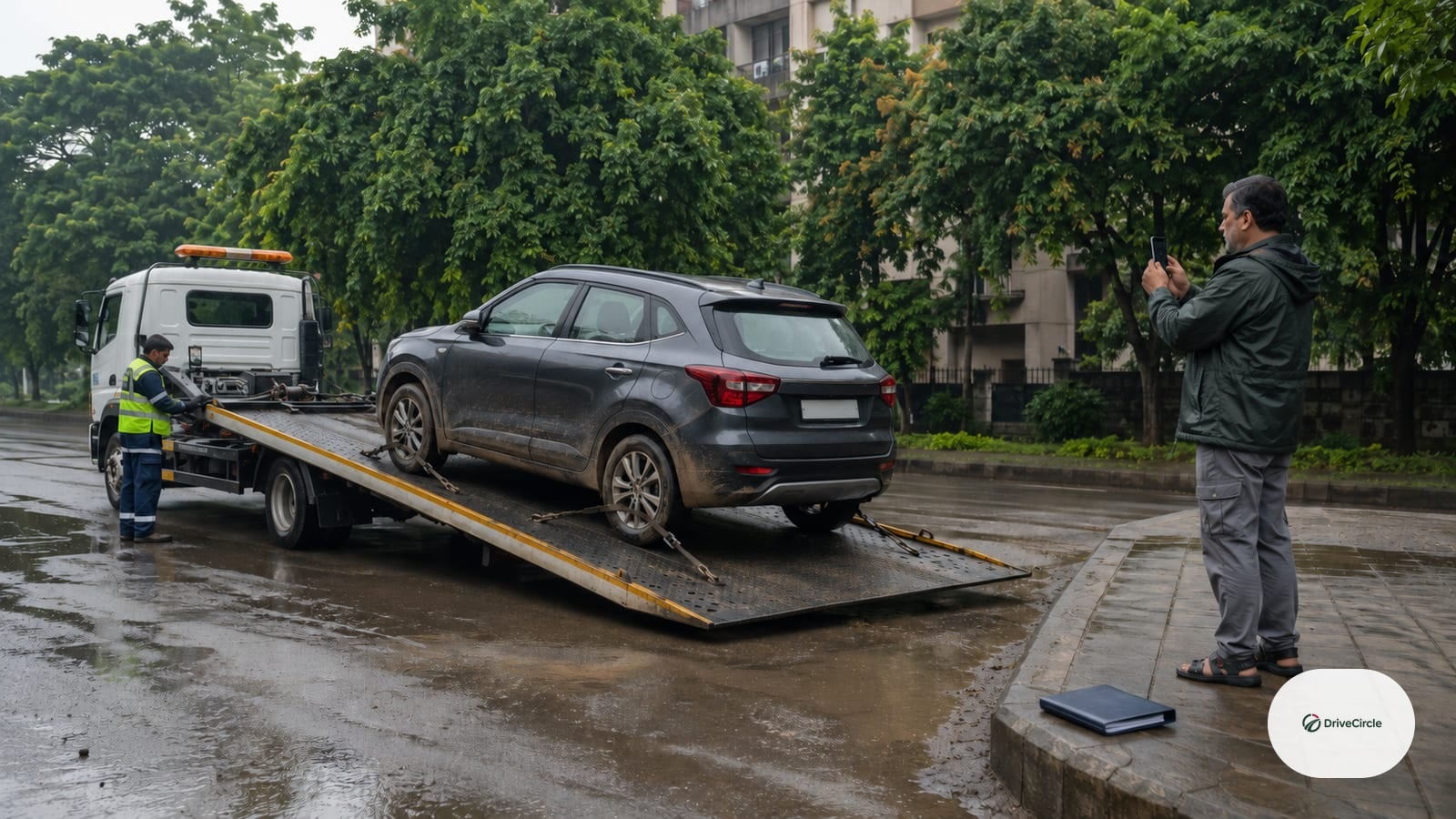
Heavy monsoon rain can change a familiar road within minutes. A shallow-looking stretch may conceal an open drain, broken road, deep pothole or fast-moving current. A vehicle ahead may cross successfully while yours stalls because its air intake, ground clearance, tyres and drivetrain are different.
The safest decision is usually the least dramatic one: stop before the flooded section and find another route.
If your car is already in the water, however, the decisions made during the next few minutes can determine whether the vehicle needs cleaning and inspection — or an engine, transmission, battery or electrical-system replacement.
First Rule: Do Not Enter Water You Cannot Assess
Never assume a flooded road is safe merely because an SUV crossed it, a bus went through, other drivers are honking, the road is familiar, the water appears calm, your car has high ground clearance, your vehicle has AWD or 4WD, or the manufacturer advertises a water-wading capability.
Ground clearance and water-wading capacity are not the same thing. Water may reach the air intake, electrical connectors, wheel bearings, exhaust, transmission breathers or high-voltage components even when the car continues moving.
Manufacturer guidance also differs between models. Some manuals refer to the wheel hub, axle hub, tyre centre or bumper as a limit. Use the guidance in the manual for your exact vehicle — don't rely on a generic number found online. Hyundai's owner guidance, for example, tells drivers to avoid flooded areas unless they are certain the water is no deeper than the bottom of the wheel hub, and warns that braking performance may be reduced after crossing. Mahindra manuals similarly warn that water may enter the engine, transmission, differentials and wheel bearings.
See Hyundai's owner's manual guidance on driving in flooded areas, and Mahindra's water-crossing and submerged-vehicle guidance.
Turn around when you cannot see the road surface, the depth is uncertain, water is flowing across the road, the level is rising, smaller vehicles are stalling, there is no clear exit, barricades or police restrictions are present, the route passes close to a drain, lake, river or underpass, or it is dark enough that road edges cannot be identified safely.
Losing 30 minutes to a diversion is preferable to losing the car — or being trapped inside it.
Why Following Another Vehicle Can Be Dangerous
A larger vehicle can create a temporary bow wave and disturbed water behind it. That may make the road look passable for a few seconds, but the wave can also raise water around your bonnet or air intake.
The first vehicle may also have substantially greater water-wading capacity, have a higher air intake, be following a slightly different path, displace water into your lane, hide an open drain or pothole, damage the road surface, or stop suddenly after crossing.
Maintain a generous distance. Never enter merely because you feel pressured by traffic behind you.
If Shallow Water Must Be Crossed
Only consider crossing when the road is open, the water is shallow and still, the surface is visible or reliably known, and the manufacturer's limits are not being exceeded.
Before entering: observe vehicles of a similar size, identify a clear exit, switch off automatic engine stop-start, close the windows, keep seatbelts fastened, avoid entering immediately behind another vehicle, select the appropriate low gear or drive mode according to the manual, and maintain space so you don't have to stop in the water.
Proceed slowly and steadily. Do not accelerate aggressively — speed creates a larger wave that can push water higher into the vehicle. Do not change gears unnecessarily, race the engine or stop midway. Manufacturer instructions differ by drivetrain, so follow the manual rather than treating these as universal directions.
After leaving the water: check that steering feels normal, check the instrument panel for warnings, test the brakes at very low speed in a safe area, apply the brakes gently several times if the manufacturer recommends doing so, listen for scraping, grinding or unusual drivetrain sounds, and arrange an inspection if water reached the underbody or wheel hubs.
Wet brakes may offer less stopping force until they dry. Both Hyundai and Mahindra advise drivers to check braking performance after crossing water.
See Hyundai's guidance on water driving and braking afterward, and the Mahindra XUV700 owner's manual.
If the Engine Stalls in Water
Do not repeatedly press the starter button or turn the ignition key.
Move yourself and passengers to safety if it can be done without entering dangerous moving water. Switch on hazard lights if the electrical system remains safe and functional. Contact emergency services if personal safety is at risk.
Once occupants are safe: do not attempt to restart the engine, do not allow a bystander to jump-start it, do not push-start a manual car. Call roadside assistance, tell the operator that the vehicle stalled in floodwater, inform them of the transmission and drivetrain type, and ask for the towing method prescribed in the owner's manual. Photograph the water level and vehicle position from a safe location, and notify the insurer if significant water ingress or damage is suspected.
A restart attempt can convert a recoverable incident into major mechanical damage.
What Is Hydrolock?
A combustion engine compresses a mixture of air and fuel inside its cylinders. Air can be compressed; liquid water effectively cannot be compressed in the same way.
If the engine draws water through its air intake, a piston may encounter water inside the cylinder. The sudden resistance can stop the engine and may damage connecting rods, pistons, the cylinder head, valves, the crankshaft, bearings or the starter motor. This condition is commonly called hydrolock or hydrostatic lock.
Not every flood-related stall proves hydrolock — water can also affect electrical connections, sensors, fuel delivery or the exhaust. But because restarting could cause or worsen internal engine damage, the safe response is to stop attempting it and arrange professional inspection.
If the Car Was Parked and Became Submerged
A parked vehicle can suffer extensive damage without the engine ever running. If water has entered the cabin or risen above critical mechanical or electrical components: don't unlock or operate it repeatedly through the remote app, don't start the engine, don't switch the ignition on merely to check the odometer, don't connect a charger, don't disconnect high-voltage components yourself, and don't assume that drying the interior makes the car safe. Contact the insurer and authorised workshop, and have it moved using the manufacturer-approved towing method.
Mahindra's manuals specifically warn owners not to start a submerged vehicle without advice from an authorised service centre, and recommend inspection for water entry.
See Mahindra's submerged-vehicle guidance.
Photograph the water level relative to the vehicle, all four sides, the cabin water level if safely visible, the dashboard without switching the ignition on, the registration number, the surrounding flooded area and any visible debris or impact damage. Record the approximate time the flooding began and receded.
EV and Hybrid Flood Safety
Electric vehicles are designed with insulated high-voltage systems and multiple safety protections, but a flood-damaged EV should not be treated as an ordinary wet appliance.
If an EV or hybrid has been submerged or water has entered the cabin: don't start or drive it, don't connect it to a charger, don't touch exposed orange high-voltage cables, and don't open or interfere with the traction-battery enclosure. Keep people away if there is smoke, heat, hissing, popping, sparking or an unusual chemical smell, and contact emergency services if there is a possible fire or electrical hazard. Contact the manufacturer's roadside-assistance service, tell the tow operator it is an EV or hybrid, and follow the emergency instructions in the owner's manual.
Mahindra's current electric-vehicle guidance tells occupants not to touch exposed orange cables and to contact roadside assistance or an authorised service centre when water has entered a vehicle or it has been submerged.
See Mahindra's electric-vehicle water and high-voltage safety guidance.
An EV may appear to function after water exposure while still requiring inspection of its battery enclosure, charging system, isolation monitoring, connectors and low-voltage electronics.
Tow the Car Correctly
Incorrect towing can damage an automatic transmission, AWD system, electric drivetrain or parking-brake mechanism.
When calling roadside assistance, provide the make and model, fuel or electric powertrain, manual/automatic/CVT/DCT transmission, 2WD/AWD/4WD, whether the vehicle is in water, whether wheels can rotate, whether the electronic parking brake releases, whether the car is in Park, and whether the steering is locked.
A flatbed is generally the safest recovery method for many submerged, AWD and electric vehicles, but the owner's manual remains authoritative — Hyundai, for example, specifically instructs that full-time AWD vehicles be transported by flatbed. Do not permit improvisation merely to move the vehicle quickly.
See Hyundai's AWD towing guidance.
What Insurance May Cover
Indian motor insurance has multiple layers: third-party liability, standalone own-damage cover, comprehensive/package cover, and add-ons such as engine protection, consumables, zero depreciation and roadside assistance.
Third-party-only insurance does not pay for flood damage to your own car.
A comprehensive or own-damage policy may cover direct external flood damage, subject to the policy's wording, exclusions, deductibles and claim assessment. However, consequential engine damage — particularly damage associated with attempting to restart a water-ingressed engine — may be treated differently unless an appropriate engine-protection add-on applies. Don't assume that "comprehensive" means every water-related repair is covered.
IRDAI advises buyers to compare the actual coverage, deductibles and Insured Declared Value rather than judging a policy only by price, and to read the policy and choose add-ons according to individual needs.
See IRDAI's motor-insurance guidance and its dos and don'ts for motor insurance.
Check your policy for: flood, storm and inundation cover; engine-protection add-on; hydrostatic-lock treatment; consumables cover; electrical-system coverage; battery coverage for EVs or hybrids; depreciation deductions; roadside assistance; towing limit; claim-intimation deadline; repair-authorisation procedure; deductible; and exclusions relating to continued driving or negligence. Coverage differs between insurers and products — confirm it from the policy schedule and wording.
How to File a Stronger Flood-Damage Claim
1. Prioritise safety. Don't remain in moving water or block emergency operations merely to collect evidence.
2. Notify the insurer promptly. Use the insurer's app, website, helpline or email, and obtain a claim or reference number.
3. State the facts accurately. Record the date and approximate time, location, whether the vehicle was parked or being driven, approximate water level, whether the engine stalled, whether any restart was attempted, warning lights or symptoms, and towing details. Don't change the account later to make it appear more favourable.
4. Preserve photographs and videos. Keep the original files with timestamps where possible.
5. Avoid unauthorised dismantling. Don't approve major work before the insurer or surveyor has completed the required inspection, unless immediate work is necessary for safety and the insurer has agreed.
6. Retain every document — policy schedule, RC, driving licence, claim reference, towing invoice, workshop job card, surveyor communication, repair estimate, photographs, emails/messages and payment receipts.
7. Ask for written reasons. If an item is rejected, ask the insurer to identify the relevant policy clause.
8. Escalate properly. Raise the complaint with the insurer first. If it remains unresolved, IRDAI's Bima Bharosa system provides a channel for registering and tracking a grievance. See IRDAI's Bima Bharosa complaint guidance.
What the Workshop Should Inspect
The exact inspection depends on water level, duration and vehicle design. It may include the air filter and intake tract, engine cylinders and lubricant, transmission fluid, differential and transfer-case lubricants, wheel bearings, starter and alternator, battery and terminals, wiring harnesses, fuse boxes, electronic control units, sensors, brakes, suspension, steering, the exhaust system, cabin electronics, seat motors, airbag and restraint modules, carpet and insulation, mould and contamination, and — for EVs — the battery enclosure and isolation system, charging system, and low-voltage and high-voltage connectors.
Floodwater can contain sewage, fuel, oil, salt, mud and chemicals. Cleaning the visible carpet without removing contaminated insulation can leave odour, corrosion and health risks behind.
Warning Signs After Driving Through Water
Even when the car did not stall, arrange an inspection if you notice difficult starting, rough idle, loss of power, a new warning light, milky or contaminated oil, delayed or harsh gear changes, grinding or humming from the wheels, weak brakes, steering vibration, damp carpets, non-working sensors, flickering lights, malfunctioning windows or seats, a persistent musty smell, unusual charging behaviour in an EV, or reduced range combined with warnings.
Water-related corrosion can appear days or weeks later. Preserve service records and report symptoms promptly.
Prepare Before the Next Heavy-Rain Warning
Before monsoon travel: check IMD warnings, avoid routes known for underpass flooding, keep the insurer and roadside-assistance numbers available offline, confirm your policy is active, understand whether engine protection is included, keep FASTag and fuel or charge sufficient for diversions, check tyre tread, wipers, lights and brakes, don't park in a basement or low-lying area during a severe warning, save alternate routes, and tell family members where the insurance and RC details are stored.
IMD provides district and subdivision-level warnings that should be checked before long trips during active monsoon periods.
See the India Meteorological Department and its district-wise weather warnings.
A Calm Decision Is Usually the Cheapest One
The most capable SUV cannot make an unknown flooded road predictable. AWD helps distribute traction; it does not prevent a vehicle from floating, ingesting water or falling into a concealed drain.
If the route is uncertain, turn around. If the engine stalls, do not restart it. If the vehicle is submerged, do not experiment with it. Protect people first, document the situation, use the correct recovery method and involve the insurer and an authorised workshop early.
Your car's ownership history should include more than fuel and service bills. Saving insurance details, roadside-assistance contacts, maintenance records, photographs and repair documents in one place can make a stressful incident easier to handle — that's the kind of complete ownership record DriveCircle is being built to support.
A few related reads: real owner-recommended road trips for planning your next monsoon-season drive more carefully, negotiating insurance, loans and accessories when you're choosing coverage in the first place, service costs over the vehicle's life for what a major water-damage repair fits into, the first 90 days of ownership for distinguishing normal new-car quirks from real damage, and what ADAS and safety features actually cover on your exact variant.
This guide provides general safety and insurance information. Vehicle capabilities, towing procedures and insurance coverage differ. Consult your owner's manual, insurer and authorised service centre for advice specific to your vehicle and policy.